Religious and Spiritual Perspectives on Mindfulness
Photo by Flickr from Pexels
by Catharine Hannay, founder of MindfulTeachers.org
Over the past few years, I've been fascinated and disturbed by the false assumptions made by many people of faith and many secular mindfulness teachers.
To give just a couple of examples:
a secular teacher was quite dismissive about Christian parents objecting to their kids saying 'Namaste' at the end of yoga practice (update: a day after posting this, I saw an interesting perspective on cultural appropriation of 'namaste');
a Christian blogger got very upset that "Breathe" by Jonny Diaz was referred to as a mindfulness song. She insisted that it can't really be a mindfulness song because it's Christian. (It's a lovely song, by the way. I included it on the All About the Breath playlist and the Sign Language playlist.)
The truth is, some people practice mindfulness (and complementary practice like yoga) in an entirely secular way. Others have a faith-based approach to mindfulness. And many people derive the same benefits from prayer and traditional religious practices.
Whenever tensions are running high, it might be useful to let go of the term “mindfulness” and focus on “contemplative practices,” instead. I think we can all agree that contemplation is possible in either a secular or religious context.
The Center for Contemplative Mind in Society created this wonderful Tree of Contemplative Practices to show the many different ways we can tap into our inner wisdom.
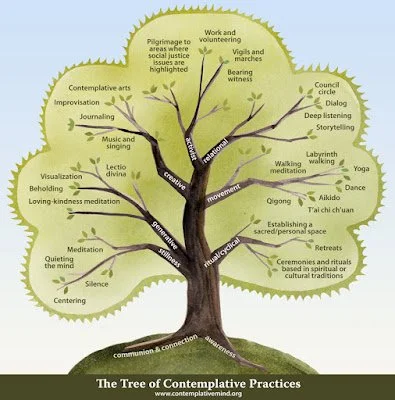
image copyright The Center for Contemplative Mind in Society
http://www.contemplativemind.org/practices/tree
We tend to equate 'mindfulness' with only one branch of the tree. Stillness: meditation, silence, quieting the mind, and centering.
But most mindfulness teachers actually incorporate practices from several different branches of the tree: deep listening, lovingkindness meditation, various types of mindful movement, and so on.
Likewise, we tend to associate religion with only ceremonies and rituals. But every major religion incorporates several other branches of the tree, including storytelling, music, and serving our communities.
It behooves us all to think deeply about our own traditions and preferences, as well as the assumptions we might be making about other groups and individuals.
I hope you find the following resources useful for exploring the many different perspectives on mindfulness and contemplative practices.
Interfaith Perspectives
How Christians and Buddhists Can Teach Each Other About Mindfulness: We tend to hear the same stories over and over within our own communities. Learning from other traditions can actually deepen our commitment to our own paths.
An Interfaith Perspective on Compassion and Service: Buddhist, Christian, and Jewish perspectives on healing the world.
Mindfulness Increases Creativity, Spirituality, and Connection: interview with Brandi Lust, author of Myths of Being Human: Four Paths to Connect with What Matters.
Thought-Provoking Videos About Mindfulness and Meditation: includes a section on mindfulness in different spiritual traditions.
Three Different Approaches to LovingKindness Meditation: Buddhist, secular, and faith-based options for this popular type of compassionate meditation
You may also be interested in Secular and Spiritual Perspectives on Gratitude, which has quotes from Muslim, Christian, Hindu, Jewish, Buddhist, and Humanist sources.