

4 Tips for Teaching Yoga to the Less Mobile
Published June 15, 2024
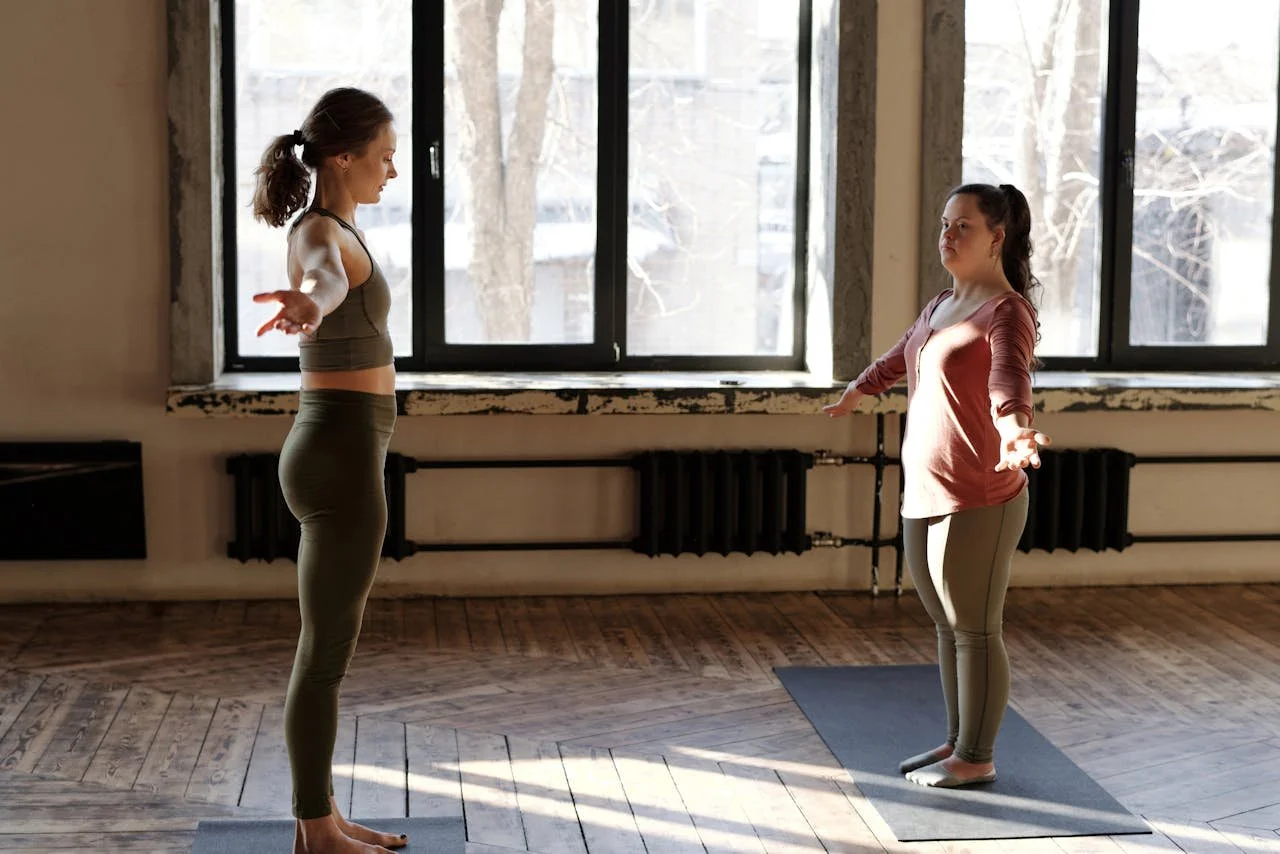
Photo by Cliff Booth from Pexels.com
by Natalie Moussaid, YT, CHWC
“The practice of Yoga meets us where we’re at and evolves as we evolve.”
Early in my Yoga Teaching journey, I remember a moment where I was left stumped …
It was right after class when I was approached by an older woman, about 85 years old. She hesitantly explained to me that she’s had surgeries on both knees, as well as her right shoulder. As a result, she mentioned that it’s been difficult for her to practice Yoga “like she used to” (a very common phrase spoken by seniors, or others who have developed immobility). She asked if I knew of any way to modify Yoga poses so that she could still build strength and balance with more ease.
Being a new Yoga Teacher, I had little to no familiarity with the realm of immobility. Therefore, I lacked confidence in my ability to help her. This lack of confidence motivated me to do more research on adaptive Yoga. At first, I did my own research on how to modify poses for specific limitations. Having some background information in modifications helped build the confidence needed to ask about any injuries prior to the start of class …
Here are five helpful resources that I recommend for my fellow Yoga Teachers of all types:
Yoga for Pain Relief: A New Approach to an Ancient Practice by Lee Albert, NMT
You Can Heal Your Life by Louise Hay,
Teaching Yoga: Essential Foundations and Techniques by Mark Stephens
Yoga for Pregnancy & Birth: A Guide for Yoga Teachers by Megan Sloan
“Teaching Yoga: Resources from Master Teachers” at yogajournal.com
At some point, almost every teacher has experienced the boggling moment when a well thought out sequence must be thrown to the wind. It’s in this moment of uncertainty that one learns the first step to teaching Yoga to the less mobile, or really to anyone. Which is …
1. Be Flexible
It’s great to be prepared for a class with a pre-planned sequence. It demonstrates dedication to delivering a successful practice.
However, what happens when you realize that the poses chosen don’t work for the whole class?
Do you (a) mentally panic and cancel, (b) plow through the poses with little to no regard for those who are limited, or (c) stay resilient and open to change?
By staying resilient and open to change, something beautiful takes place in the Yoga space, as well as in the heart. As a teacher, staying situationally flexible helps to increase versatility in the art of movement. Staying open to the needs of others and being able to offer adjustments adds to one’s credibility as a teacher.
For example, I remember teaching Beginner Yoga classes for a few months. One day a student arrived who had difficulty with poses that required bending at the knee. Rather than ignoring the student’s limited mobility, I made a quick assessment. The woman appeared to be older, about in her late 60s.
Now, I knew that as people age, their bone density decreases, muscle mass drops, balance may be poor, and the risk of injury becomes much higher. However, I could tell that there was something more contributing to this woman’s inability to stand strong and balanced. (Later I discovered that she suffered from a severe head injury).
As I flowed through my planned sequence, my mind couldn’t help but drift to all of the questions I had - what other poses can I do? How can I modify it? What will the other students think if I start teaching for the less mobile student?
I had been creating and practicing my sequence prior to the class for days. So, I felt some pressure wash over me when my foundation for that class shook. Almost all of the poses I included required bending at the knee, or shifting from standing to floor poses. And unfortunately, I didn’t have many props she could use to modify the poses. So, instead, without calling too much attention to that particular student, I mentally rehearsed a change of sequencing.
Rather than focusing on the lower body, I decided to shift awareness to the muscles of the neck and heart center. I chose stretches and Yoga poses that were challenging, but manageable for every participant. Doing this helped to prevent any discomfort or potential injury for the less mobile student. It also empowered her sense of confidence and worth.
Although this experience was initially difficult, I felt a deep sense of purpose when I decided to be present and flexible. Having this woman as a student reminded me of the beauty of Yoga.
The practice of Yoga is more than just physical poses. The practice of Yoga meets us where we’re at and evolves as we evolve. It’s a compassionate, malleable art that can be adjusted to meet the needs of each person.
For teachers, Yoga can deepen our sense of empathy and curiosity. We develop a deep connection with our students, making our practices heart centered. Instead of desiring just physical improvements, we seek to help others evolve multi-dimensionally. Our minds expand to welcome new creative ideas that will benefit our students in more ways than one.
2. Create a Welcoming Environment
Walking into a room that feels like a breath of fresh air can enhance the Yoga class experience. Imagine a room that emanates the ambience of relaxation, balance, and trust. But … How does a teacher make a room feel so comforting?
Sure, you could paint the room a soft pastel green, or an earthy light brown. Maybe add a small waterfall, or plants to bring the restorative elements of nature indoors. The feng shui of a room definitely influences one’s experience. However, that may not be something you can control.
I remember the first time instructing as a Yoga Teacher in a senior living community. I was guided to a modest-looking theater hall. Definitely not your typical Yoga Studio! We were surrounded by unmatched carpeting, dull lighting, and chairs that were unconducive to Chair Yoga. I couldn’t help but wonder how I was going to engage this class in a room without adequate props.
That wasn’t the first time resources were limited in my Yoga Teaching setting …
In 2020, I held a Yoga and Breathwork workshop for an Adult Education class. This class was hosted at a local high school. When I entered the class, there were desks and chairs scattered throughout the room. There was no space to conduct this Yoga session. Or, any props to help modify it. I felt unprepared and limited in what I could offer my students.
Of course it can be discouraging when a teacher has little control over their environment. In some cases, teachers may feel inadequate, or even embarrassed about what students may think. However, I’ve discovered that some of the tricks to avoid these limiting beliefs are to uphold resourcefulness and creativity. Teachers must learn that the power to create a successful Yoga space is within them, not the four corners around them.
In order to create a safe and welcoming environment for students to explore their bodies and minds, it takes a lot more than what’s hanging on the walls … or lack thereof.
Here are three suggestions that any Yoga teacher can implement to ensure the safety and comfort of their students.
Greet with a welcoming introduction.
The first tip is quite simple but powerful. A warm welcome and a thoughtful introduction make a great impact on how students feel in class. Before starting a new class, perhaps come up with a brief biography to share about yourself. Students enjoy learning about their teacher, and it helps to establish a greater sense of trust. Remember that a student will almost always remember how they felt during and after the class more than anything. If a student felt welcomed, supported, and was able to connect with the teacher, they’ll return.
Be sure to ask about any pre-existing injuries or health concerns.
Asking about injuries or health concerns is important for the safety of participants. This can be a sensitive topic for some. However, as a teacher, it is crucial to have some insight about the limitations of each student. Having such insight helps to create a class that can adapt to the unique needs of each person.
I’ve discovered that by asking this question, students are less hesitant to discuss their concerns. The openness of that question allows them to speak about their limitations and relate to others with similar imbalances in a safe environment. Thus, asking this question helps others with limitations to feel more connected and safe.
One of the best parts about being a Yoga Teacher is creating a space for people to feel seen, heard, and nurtured.
Which leads me to the last aspect of a welcoming space.
Accept, respect, receive.
Accept: Be open to all people who walk into the Yoga space. Always know that no matter who or how many people show, they are there for a reason. Accept each student where they are at - spiritually and physically. If there is a student who you know you can’t assist, do your best to guide them to a resource that can better guide them along their journey.
Respect & Receive: Treat each student with respect. Show kindness to all, regardless of differences such as race, gender, religion, economic status, or mobility. Understand that each person is highly valuable. Therefore, we must receive each person with empathy and non-judgement.
Those with limited mobility may suffer from low self-confidence and poor body image. This is because outsiders may perceive them as “weak,” “different,” “strange,” or “unintelligent.” These negative perceptions can have detrimental effects on a person's overall mental and emotional well-being.
As teachers, it’s important to receive all students with acceptance and respect. Doing so helps to empower self-confidence, especially amongst the less mobile. It will also influence the way other students treat their classmates.
3. Get in the Know
Before beginning a session, make an effort to learn about the clients. Try not to assume needs and goals, especially for those with limited mobility. Making assumptions about a persons’ needs may make them feel incapable. They may see themselves as someone that requires more “fixing.” So, instead of trying to fix a person, it’s best to ‘get in the know’ about them.
Notice that the word “now” is highlighted in “know”. To get in the know, one must first practice present moment awareness. Being grounded in the present moment allows one’s mind to expand. It also creates a sacred space for active listening and deep reflection. Two elements that are essential for learning more about those who attend each class.
Being attentive in the present allows teachers to clearly know the true needs of each person.
4. Remember That Every Body is at Different Stages
Everybody and every body is at different stages of development. Honoring these differences is important as a Yoga Teacher. Being accepting of each unique person creates space for their potential to be discovered.
Someone who is healthy, fit, and experienced will require a different level of nurturance than a senior with multiple surgeries. Also understand that people who fall into the same “group” will be at varying stages. Therefore, once more, it’s important to be open to differences, as well as the evolving needs of each person.
I remember filling in for a Yoga Teacher who taught Chair Yoga for seniors. This was the first time that I taught an entire group the practice of Chair Yoga. Although I had familiarity with adaptive chair Yoga, I never had the opportunity to instruct a whole class.
Before teaching the class, I had an image in my mind of how the participants would perform. I wanted to ensure that the class was gentle, since I knew there would be seniors with walkers, canes, and wheelchairs.
To start, I explained to the participants that the class would be slow moving and restorative (assuming that it would meet the needs of everyone) …
Although it appeared that most of the class enjoyed their experience, there were a few who expressed different thoughts. One man in particular explained that he liked the class, but it was too slow for him. Of course, his comment surprised me because he was one of the participants using an assistance walker. I assumed that this man, and others in a similar position, would require very slow-moving poses. It was at this moment that I realized not everyone is at the same level. Even those who fall into similar groups are at different stages of mobility and thinking.
Conclusion
As I began my journey as a Yoga teacher, I came to understand that in the world of Yoga, there are many different types of teachers, just as there are many different types of students. The beauty of Yoga is that it is easily adaptable to meet the needs of each teacher and student. A great teacher will emphasize the adaptive element of Yoga, as well as the concept of flow, in their classes.
Yoga Teachers have the ability to empower other peoples’ potential where it is not seen.
Yoga is a beautiful art that fills up the hearts and minds of many. It is a practice that inspires wisdom both on and off the mat. As a Teacher, it’s fulfilling to be able to share the physical, mental, and spiritual benefits of Yoga. Being able to share the power of Yoga becomes even more purposeful when it inspires those who are limited in mobility.
About the Author

Natalie Moussaid is a Yoga Teacher and Certified Health and Wellness Coach.
She specializes in emotional healing, spiritual connection, nature connection, and mind-body movement.
Related Posts
There are many more resources for yoga teachers here at MindfulTeachers.org, including the following posts: