Communicating Across Difference: Quotations for Reflection and Discussion
published October 8, 2025
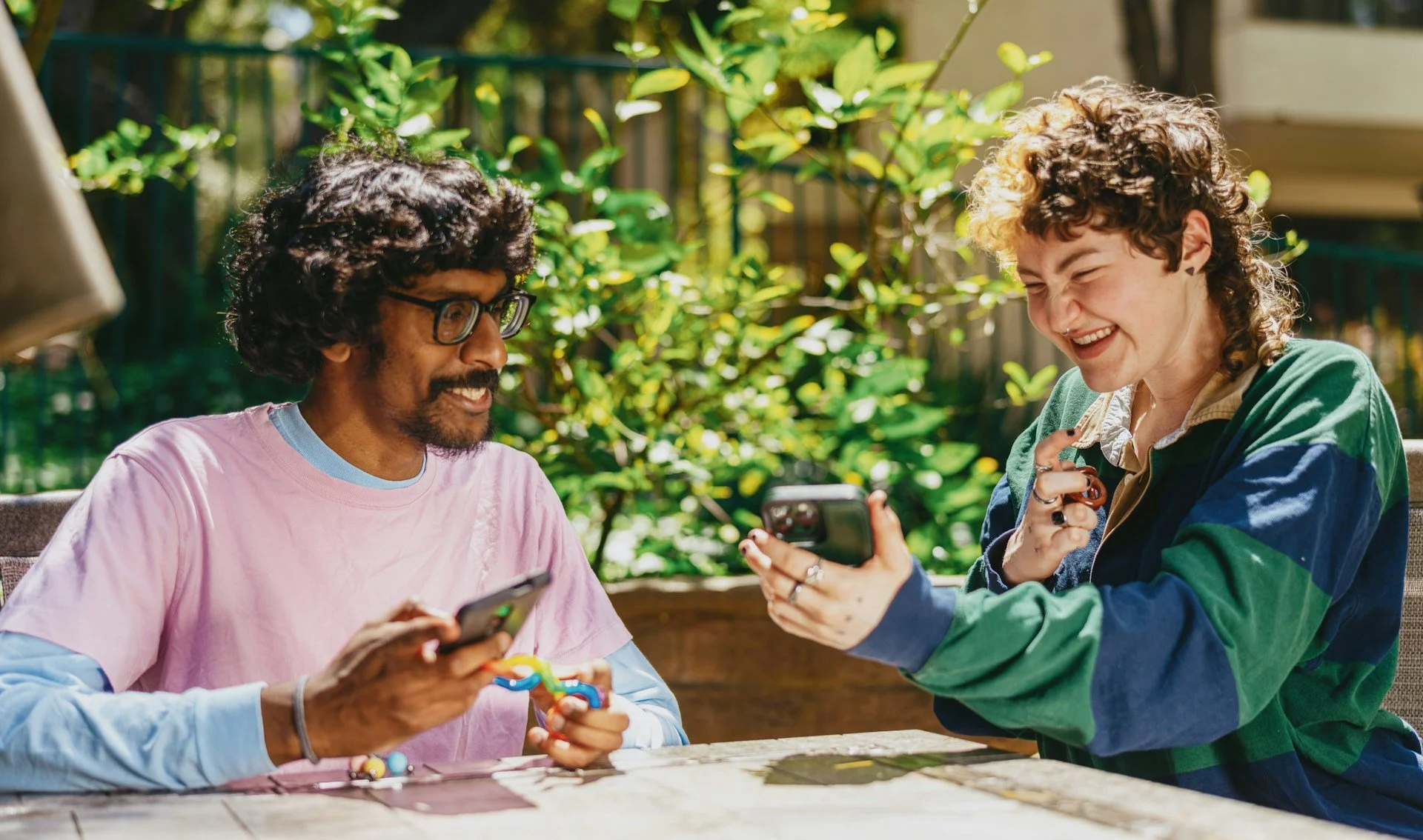
Photo by Hiki App on Unsplash
by Catharine Hannay, founder of MindfulTeachers.org
Continuing the series of Quotations for Teaching Mindfulness and Compassion, here are a variety of perspectives on miscommunication, recognizing differences, and learning from each other.
Teachers, please note:
I don’t necessarily recommend giving this whole list to your students—I like to provide a lot of options so you can choose what’s most appropriate for your particular context.
I’ve included links to book titles just so you can see more information about the sources of these quotes. (I don’t accept any paid links or advertising.)
Scroll to the bottom of the post for questions that can be used for personal reflection or as prompts for discussion and writing.
Miscommunication
“Which part of Mexico are you from?”
“Paraguay.”
from the film Bottle Rocket (1996) by Wes Anderson
“My phone doesn’t observe the high holidays, autocorrecting shana tova to shaman tobacco, Rosh Hashanah to rose has hands.”
Maggie Smith, Goldenrod, p. 22
“I attended a literary discussion with a white speaker whom I know […] discussing immigration as it relates to the Latine population. She gave a statistic, and then looked at me and asked, ‘Isn’t that right, Alex?’
[…] She singled me out—the only Latine person in the room—to give credence to her statement. […] How ridiculous is it to assume that people of color walk around with statistics about their community on hand?”
Alex Temblador, Writing an Identity Not Your Own, p. 65-66
Literacy specialist Deborah L. Wolter is deaf and communicates through speech and lipreading:
“A colleague marched into my office, wagged her finger back and forth, and announced loudly, ‘Meeting, no!’ Of course, I had no idea what she was talking about.
She kept repeating herself, enunciating in a wildly exaggerated manner […] ’Meeting, no! Meeting, no!’ I was scrambling to ask specific questions. […] Was a meeting cancelled? Or was there no meeting scheduled that needed to be? Finally, she stormed off in exasperation […]
Later in the day, I approached her and requested that she talk to me in full sentences about the meeting. Instead, she rattled off a litany of things […] which I should be seeking to cure my hearing loss. And I still had no information about the mystery meeting.”
Ears, Eyes, and Hands, p.43-44
Recognizing Differences
“A musician from India once asked me how I could ‘hear the music’ during a Brahms symphony. I asked what he meant; after all, with an eighty-five piece orchestra cranking away at 100 decibels, it’s pretty hard not to hear the music.
He replied that the music, in his brain, was obscured by too many people playing at the same time. This is the essential difference between Western classical music, which adds sound until it is ‘right’ (hence the huge orchestra, in the case of the Brahms symphony), and an Indian classical raga, which discards all sounds that obscure the ‘true music’.”
Arthur C. Brooks, From Strength to Strength, p. 66-67
“As a first-generation Caribbean American, my experience in America will be different from that of a first generation German-American, which will be different from that of a first-generation Chinese-American, and so forth—even though, as first generation immigrants, we may have certain things in common.”
Kwame Christian, How to Have Difficult Conversations About Race p. 72
“It’s kind of like that for everyone, isn’t it?”
“No, it isn’t! Would you tell someone with asthma, ‘Well, I get out of breath when I run, too!’
No! See, it’s not the same.”
Julie Dachez, Invisible Differences: A Story of Asperger’s, Adulting, and Living a Life in Full Color
“I have been to more funerals than
most of my non-Native friends and
I have to listen to them say they relate
when they will never fully understand
I’m not just grieving my relatives but
every single bit of knowledge lost
when so much
has already been stolen.”
from the poem “Growing Up Pueblo (and White) in America” by Somá Toya Haaland (Laguna, Pueblo), from My Life: Growing Up Native in America, edited by IllumiNative
“Don’t get antsy with people when they screw up your preferred pronouns. Even when they want to remember, people will get it repeatedly wrong. They have to rewire their brains to adjust and that’s not easy, it takes time.
[…] Morgan (no longer Megan) has self-identified as gender-free for six years now. They’ve learned to be cool with it when people don’t use or understand their preferred pronouns.
Initially they wanted to punch their lights out.”
Bernadine Evaristo, Girl, Woman, Other, p. 328
“I was too poor to go to sleepover camp as a kid. But people in my circles can’t seem to resist sharing fond memories of various expensive enrichment activities they took part in as children. […] And I understand the discomfort of being on the other side of that exchange.
When I lived in L.A., where college degrees are less common than in the media world, I sparked many an awkward silence by asking people I had just met, ‘Where did you go to college?’
We assume people on equal footing with us had identical trajectories, and revealing the differences can be painful.”
Olga Khazan, Weird: The Power of Being an Outsider in an Insider World, p. 211
“Xiomara described sadly how she called herself an Anglicized nickname she hated, ‘Zara,’ because non-Hispanic people couldn’t be bothered to learn how to pronounce her real name. Susan, a white woman, responded ‘I know how you feel. A lot of people call me Suzy and I hate it.’ Everyone but Susan immediately cringed. […] Having a common, easy to pronounce nickname is not the same as being forced to hide one’s cultural identity to assimilate.
True empathy means that we try to imagine what it’s like to be other people, to walk in their shoes, and not simply to see them as carbon copies of ourselves. When you hear people saying, ‘I really couldn’t understand him or her; after all, if I was him or her I would do this and not that...,’ this is an issue of lack of empathy because understanding that someone is different from you is the first step to trying to work out what it is they are really feeling and how they are different from you.”
Paul Gilbert and Choden, Mindful Compassion, p. 116
“As much as you want and need to empathize, there are limits to our empathy. When my wife was in the hospital delivering our second son, I knew she was uncomfortable and in pain, but I couldn’t fully empathize because I’ve never had the experience of being pregnant and never will. The same will be true in some of your conversations, especially about race, not matter how well you listen. And that’s okay. Listen and learn with the goal of understanding the other person as much as you can, but with the knowledge that your understanding will always be incomplete.”
Kwame Christian How to Have Difficult Conversations About Race p. 88
“Practicing honest diversity means refusing to make assumptions about people based on their group membership. It means digging deeper and asking questions like “what’s your personal perspective on this?” rather than “what is the [INSERT LABEL] perspective on this?” […] Having a shared identity does not amount to being identical. This is true not just of people within minority communities but also of those who belong to majority groups (like cisgender, straight, white men).”
Tania Luna, “Beyond Labels,” Psychology Today.com
Learning from Each Other
“The only way we ever get used to something unfamiliar is by asking about it, exploring it, seeing it from different angles. And when the ‘unfamiliar thing’ is a person, getting curious about that person’s experience cuts through anxiety and leads to connection.”
Martha Beck, Beyond Anxiety: Curiosity, Creativity, and Finding Your Life’s Purpose, p. 151
“There is no such thing as inter-religious dialogue in general, rather there is dialogue between this Christian individual and community and that Jewish or Buddhist or Hindu individual or community. Practice in one kind of dialogue prepares one for the next, but each requires new learnings and new openness. Each brings new challenges and new blessings, too.”
Brian McLaren, A Generous Orthodoxy
“Speak without silencing others. Listen without losing your own voice.”
Maggie Smith, Keep Moving, p. 155
“We are now living in a global village, and people from other cultures and religions are our neighbors. There are two very different approaches available to us: adversarial, or mutual enrichment. In the adversarial approach, the focus is on where we’re different, and the differences are often used to construct fences between us. In the mutual enrichment approach, the differences are not denied or ignored, but the focus is on the gifts we can offer to one another and the things we can learn from one another for the enhancement of our lives. Which approach do you choose?”
“Are yoga and meditation the right practices for you at this time?” by Fr. Tom Ryan, CSP, and Molly Metzger, at ChristiansPracticingYoga.com (article no longer available)
“Once we become better informed, we have a responsibility to share our knowledge. […] Clueing people in does not mean getting up on a soapbox to give a condescending lecture. It means being aware of the fact that there are people who are exactly where we were before we knew better. How would we have liked that knowledge to have been passed on to us? Through kind and compassionate conversations, we can become a resource for others, to help them avoid or correct missteps.”
Ash Beckham, Step Up, p. 45
“The Roman poet Terence wrote a line that was once famous: Homo sum, humani nihil a me alienum puto— ‘I am human, and nothing human is alien to me’—and I think this strikes precisely the right note. Terence doesn’t say that everything human is fully accessible to him, that there are no relevant divides of race or class or sexual orientation or religion; he doesn’t say that everyone else is instantly or fully comprehensible to him. He says, rather, that nothing human is alien to him: nothing human is beyond his capacity to understand, at least in part.”
Alan Jacobs, How to Think: A Survival Guide for a World at Odds, p. 123
“I don’t know what I will be when we are us and I am not me anymore.”
“Maybe becoming the us is where our story really starts.”
Drew Beckmeyer, Stalactite and Stalagmite
Questions for Reflection and Discussion
As always with personal topics, please respect your students’/clients’/trainees’ wishes about how much they choose to share with you or with the group.
Which of these quotations is most similar to your experience? Why?
What is your preferred means of communication (for example, reading braille or signing Auslan or texting in Spanish)? How many other ways can you communicate with others?
What ways have you found (or would you like to find) to maintain your own identity while learning from people with different perspectives?
Have you ever had a frustrating experience trying to communicate with someone who didn’t understand something about your identity? What happened?
Do you have any close friends or family members whose perspective is quite different from yours? How have you learned to communicate with each other?
Related Posts
There are many more resources here at MindfulTeachers.org for teaching compassion, communication, and community-building, including the following posts: