

Transitioning Mindfully Throughout the School Day
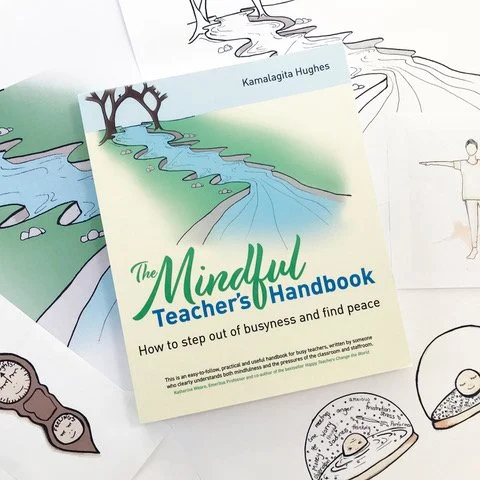
by Kamalagita Hughes, adapted from her book The Mindful Teacher’s Handbook
The school day is built on small transitions. Examples of these are: leaving the car to enter the school, going from lesson to lesson, before or after yard duty, going from communicating with a group such as a class or staff meeting to more focused communication with one other person like a pupil or parent.
Making transitions in the school day can be difficult – with so many events and decisions happening quickly, your mind is constantly being shaped by what’s gone before or anticipating what’s to come. So how can you stay focused and fresh?
Let’s have a look at how mindfulness can help you manage the school day and transitions better.
Why Transitions Can Be Challenging
Transitions can feel painful – you may have to peel yourself away from an event you have enjoyed, like teaching your favourite year group, and face something less appetising, such as yard duty. On the other hand, it can feel like a relief to get away from an experience such as a lesson that has been unpleasant and on to something that will hopefully feel a bit better. Or you may already feel full up from what’s happened so far in the day, so there is a daze or confusion in your mind about what’s coming next.
Whichever it is, it’s during these transitions that autopilot tends to kick in most strongly. With no space to think or act differently, habit tends to take over. Autopilot is a useful strategy for some things, but if it becomes your modus operandi, then life can feel mechanical and you’ll be less effective. Also, when you’re in autopilot, you’re more likely to react, because your actions are automatic. Reacting is that knee-jerk response – without thinking, you do what you’ve always done and hope for the best.
How Mindfulness Can Help with Transitions
Mindfulness allows a more thoughtful and creative option to emerge. To access this you need to give yourself some space, to step out of autopilot. That’s why engaging with transitions mindfully can become a moment of clarity, sustenance or resetting yourself. Transitions are a natural part of life – each moment is constantly unfolding from the next, so there’s an opportunity. But you need your wits about you.
The first way that mindfulness can help is acknowledging the transition: things are changing, you are moving from one activity to the next. This doesn’t need to take long, just a conscious registering that this is what’s happening (whether you like it or not).
Next, you need to create some space for yourself, no matter what time constraint you have. You can spend a moment feeling your feet on the floor, focusing exclusively on the breath, checking in with yourself and noticing how you’re doing. You can ask yourself, ‘What’s my internal weather right now? Sunny, rainy, dull or bright?’ That gives you information about what you need to do and how you need to do it, next.
Other ways to create a mindful transition are: if clearing up at the end of the lesson and on your own, you could choose to stretch or take a few breaths, rather than rushing blindly into the next activity. When eating lunch you can just focus on tasting or enjoy the company of colleagues as you do so, rather than wolfing it down in front of the computer. At the start of the day when you’re arranging the class, you can spend a few moments tuning in to set yourself up for the day. All these are very simple practices that won’t take very long, but they do make a difference. You can do these in a few minutes, or seconds if needed!
Why this matters: from doing to being mode
A few years ago Ladybird, a much-loved children’s book brand, published various parodies, one of which was The Ladybird Book of Mindfulness. The character on the front cover is a long-haired hippy, wafting around in a field. Inside, one of the scenarios reads:
“Alison has been staring at this beautiful tree for five hours. She was meant to be in the office, tomorrow she will be fired. In this way mindfulness will have resolved her work related stress!”
This captures the stereotype about mindfulness, that you have to stop doing everything and do nothing. However, practising mindfulness isn’t about doing nothing. But it is about stepping away from a driven doing mode. The driven doing mode is fuelled by autopilot – you feel driven and compulsively do things or think you should be doing them. You can’t seem to stop yourself and find it hard to switch off. The worst thing about it is that you might know rationally that these things don’t have to be done right now. But you are in the grip of frenetic activity. It’s no wonder so many people fantasise about retiring, a time when you can finally have some peace and quiet.
However, there is an alternative to the driven doing mode, which is a mindful being mode. But that doesn’t mean giving everything up and doing nothing, like the woman in the scenario. The being mode means that you give yourself some time to be, even while you are doing. You notice when you are feeling driven and stop, do a short mindfulness practice to recentre and ground yourself, and then carry on. You may have to do this several times a day, but it means you will carry on with your day feeling more contented and purposeful rather than ineffective and ragged. Like any new habit, it takes practice, but the more you practise, the more it will come naturally.
This is why it’s really important to see transitions as an opportunity to step out of driven doing mode and into mindful being mode. A perfect way to punctuate your day with a mindful pause is ‘The mindful minute’ exercise.
The Mindful Minute
Everyone has a minute. Set a timer on your phone or use the minute hand on your watch. In a minute, see how many whole breaths (in and out) that you take. Breathe naturally, don’t change your breath and just count how many you do in that minute. It doesn’t matter how many. Just note them down. Now you know how many breaths you take in a minute – if it was 12, for example, you just take that number of breaths consciously when making a transition. Or do them anytime you feel stressed or overwhelmed.
Of course, practising mindfulness during transitions during the school day isn’t the only place you can do it; you can do it in other areas of your life, too. So in the run-up to the day you can allow yourself to come into the world of the senses: when you have a shower or drink a cup of coffee, really notice the sensations, the taste, the temperature, and enjoy them. You can connect with your children, partner or pet when they wake up or be present when you’re making their packed lunch/feeding them. On the drive to work, you can notice indications of the changing seasons in the trees or wholeheartedly sing along to your favourite tune! All these help you feel calmer, more grounded and ready to face the day. You may do these things already, but give yourself permission to really value them as an important part of your day.
At the end of the school day, if you feel exhausted and spent, you are more liable to be in autopilot and to react. It’s unfortunate that many people who give to others professionally during the day don’t feel they have the time or energy to give to their loved ones. However, you can use these transitions to change modes.
You can spend a few minutes breathing and checking in with yourself before you enter your home. At home, do something deliberate to signal to yourself that you’re changing modes, such as having a cup of tea or spending a bit of time in the garden. If you live with other people, be curious about them, ask them what their day has been like, focusing on them. In turn, take the opportunity to say how your day has been. Although simple, all these steps can help make the transition from driven doing mode to mindful being mode and have an energising effect.
Mindfulness is not a magic wand to life’s troubles – but just by becoming aware and giving space to the unfolding nature of your experience, life can feel more purposeful, satisfying and fun!
Why this matters
The unrelenting nature of a school means that autopilot can easily take over and you end up rushing to the next activity, contributing to you feeling exhausted at some point in the school day. It’s in the transitions, from moment to moment, that there’s an opportunity to become more grounded, focused and energised. You can notice the transition and choose to make it a moment of calm and resetting.
These pauses have power; they remind you that each moment is a new opportunity to start again. In this way you can start to step out of the driven doing mode into mindful being mode. This is a new habit and will take time to establish but will be well worth it.
The main argument for choosing mindfulness and awareness during transitions is that awareness changes everything. Once you realise that you can cultivate this faculty then your whole experience can change. The fabric of life becomes different – lighter, more vibrant, finer.
Adapted from The Mindful Teacher’s Handbook, ©Kamalagita Hughes, 2022. Used with permission. crownhousepublishing.com
About the Author

Kamalagita Hughes has been practicing mindfulness for 25 years and teaching it for 15. She is a qualified teacher and lecturer with substantial experience in the classroom and in teacher training, further education and higher education. Kamalagita is also the education lead for Mindfulness in Action and a lead trainer for the Mindfulness in Schools Project (MiSP).
Related Posts
There are many more resources on self-care for educators and mindfulness in schools here at MindfulTeachers.org, including the following posts: