Balancing Action and Contemplation: Q+A with David Harper
published July 3, 2023

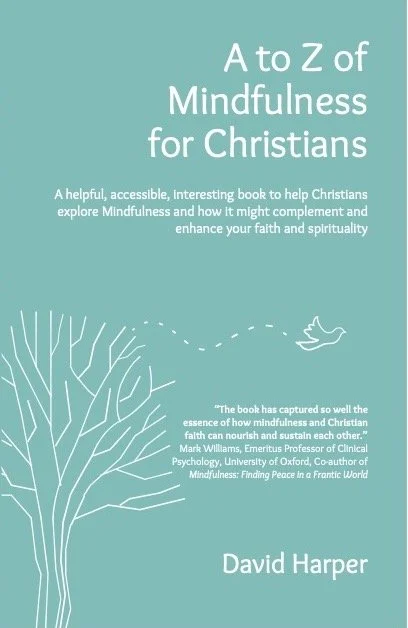
David Harper worked for the University of Oxford for more than 30 years, most recently as Bursar for Blackfriars Hall. He currently volunteers at the Oxfam Bookshop, Witney and is also very involved in the Witney Community Fridge and Larder. He is the author of A to Z of Mindfulness for Christians.
In this Q+A with Catharine Hannay, founder of MindfulTeachers.org, David discusses the need for pauses in a busy schedule, and how to accommodate different perspectives within a mindfulness group.
Catharine: You helped organize a mindfulness drop-in group which welcomed members of different faiths as well as agnostics and atheists. Were there any moments of tension or misunderstanding, and if so, how were they addressed?
David: The particular group referred to in the book, we had an incredibly skilled facilitator who would describe himself as a ‘Liberal Christian’. He was welcoming to all, and created among the whole group a tolerant and inquisitive atmosphere. I believe the use of language was a key factor. For example, at the start of each session we began with a short prayer but rather than use terms like ‘Father God’, instead phrases like ‘source of life’ or ‘source of love’ were used.
I hope that my book might encourage Christians, along the whole spectrum from liberal to conservative to welcome mindfulness and also to welcome those from no faith or other faiths.
I personally have had great pleasure and stimulation from conversations with folk from all kinds of backgrounds, including Jews, Sufis, Buddhists, atheists, and agnostics.
Catharine: In your book, you explain the concepts of ‘non-striving’ and ‘non-doing.’ How do these concepts apply in a competitive educational setting, where it seems that the only way to keep up is through constant striving and doing?
David: This is a really good question. Lack of time or not having space in the day for ‘non doing’ or ‘non striving’ are often cited as reasons for shying away from mindfulness. It seems to some like one more chore to fit in, like doing the ironing.
My particular experience in the educational setting was management and administration (of colleges or departments). In these environments, demands were high, funding constantly being sought, and excellence being pursued. At times it seemed like there was no time or space. And yet, to have portions of the day for non doing or non striving, I believe positively and significantly affected the remainder of the day. For me, not only did it affect the day but also affected the night. My sleeping patterns were adversely affected by the stress and struggle, but mindfulness certainly helped significantly.
Catharine: In a well-known biblical story, two sisters welcome Jesus to their home. Martha scurries around preparing everything, then asks Jesus to scold Mary for just sitting at his feet rather than helping her with all the work. Instead, Jesus tells her that Mary has ‘chosen the better part’ because she is listening to him attentively.
In your book, you mention the ‘Marthas’ of the church, who serve and serve to the point of exhaustion and resentment. I think there are also a lot of ‘Marthas’ in educational settings and social services.
As a committed volunteer yourself, what advice would you give to someone who’s trying to find the right balance between being a ‘Mary’ and a ‘Martha’?
David: The Mary and Martha story I have found is a good discussion starter. Many people readily identify with either Mary or Martha. And in doing so, can excuse, or even defend their approach to life. Without activity (eg setting out chairs providing refreshments etc) it can be argued that contemplation groups might not happen. However, without the contemplation, what is all the busyness and activity for?
If individuals are open, the Marys and the Marthas can develop understanding from each other. If individuals are open, they can also develop understanding of themselves. This can perhaps lead to change and perhaps towards a more abundant life.
For me since taking early retirement and being involved in voluntary activities, I am fortunate to have more time and space to notice and to be present. And also perhaps have more opportunity to decide in each situation whether to be more like Mary or more like Martha. I continue to seek wisdom from the story.
Catharine: You raise an interesting question in your book about whether the experience of mindfulness might be different for introverts and extraverts.
What are some ways a mindfulness facilitator could accommodate the needs of participants with different needs and preferences?
David: Thank you for raising this question. In the book I mention one significant difference between extroverts and introverts which is the background noise level that distracts disturbs or stimulates. Since writing the book, I have become even more aware of noise levels.
One good example is in coffee shops. For some people, extroverts, it appears to be a performance. For others, introverts, an invasion.
In a mindfulness group, a skilled facilitator can help both the extroverts and introverts. An unskilled facilitator can do the opposite! I once went to a session where the person leading used a CD and speaker to project a Dalek voice to encourage us to meditate. For me, this was quite the worst session I ever attended.
I do hope the chapter in the book helps everyone to a little bit more understanding of those around them whether they themselves are extroverts and introverts.
Catharine: What does your personal mindfulness practice look like, and how has it evolved over the years?
David: I would like to identify and separate what, in my mind, are the two elements to mindfulness practice. One element is the time set aside for meditation. The other element is being mindful in everyday activities (walking to work, washing up etc etc).
I am not a psychologist and do not fully understand the strong evidence from a large number of sources that the meditation time changes the plasticity and the shape of the brain. Harder to measure are the effects of mindful activities.
From the start of my involvement with mindfulness, the meditation has been the harder part. But incorporating mindfulness in day to day activities the easier part. Most of my practice is on my own and for varying lengths of time for the meditation. When lockdown came along I left the weekly ‘in person’ group and am now involved in a twice weekly Zoom group.
I find meeting and participating with others beneficial. However, many people that I have spoken to say that they get on pretty well by themselves with an app (e.g. Headspace) because of the flexibility that it offers.
Any practice, whenever or wherever it is possible, is beneficial!
Related Posts
There are many more resources here at MindfulTeachers.org on Christian and interfaith approaches to mindfulness, including the following posts: