Survey Says… Mindfulness Works! Quick and Easy Ways to Collect Data to Support Your Program
published September 19, 2022

photo by Lukas from Pexels.com
by Jana York, author of U is for Understanding: Clare’s Journey toward Mindfulness
When teaching mindfulness to children, my goals are to:
aid them with self-regulation,
improve their social emotional learning, and
share with them how appreciation and gratitude can help with positivity and happiness.
You probably have similar goals for your mindfulness program, but how do you know if you’re meeting these goals? And how can you convince students, parents, and other stakeholders that your program is successful and beneficial?
Personally, I feel interviewing the students through video and written testimonials is the most powerful method (and it has the added benefit of building students’ self-confidence, as well). Regardless of the method you decide to use to report your results, keep in mind that student feedback helps verify to the teacher, parents, and administrators that the kids are comprehending and implementing the skills and techniques taught in your mindfulness program. Also, as workforce turnover becomes more prevalent, having recorded data will help your successors recognize that mindfulness has been an integral part of student learning and growth mindset.
For mindfulness programs to be sustainable, the data collection, testimonials and outcomes, need to be not only recorded, but presented and shared with administrators. This bottom-up method helps to show leadership that your programs are purposeful and effective.
Sharing your program success communicates that you are making an impact and are worthy of continued implementation. I was fortunate to receive a grant with funding to support additional training and supplies primarily because of collecting and sharing data that showed the positive results of a pilot program.
The following are the results of surveys I conducted with my students. Each course included 2x weekly sessions of 15 minutes each using the Mindful Schools curriculum.
Components included
Mindful cues taught to encourage the students to be still with a wakeful posture allowing their eyes to close (if that feels comfortable) while focusing their attention on their breath.
Students spent time learning how to observe their thoughts without judgement and to explore the wandering mind with curiosity.
They learned skills such as finger breathing, and 10-count breaths to help calm themselves when nervous or upset.
Students engaged in role playing activities to gain a better understanding of feelings and emotions as well as body image.
They took part in sessions with “heartfulness” and “caring on the playground” scenarios.
Many students reported that they used mindfulness to pause when frustrated or angry with their siblings and/or friends.
Other activities included using their senses through mindful seeing, listening, walking, and eating.
Data collection tools:
MAAS-A: Mindfulness Attention Awareness Scale for Adolescents (Brown, West, Loverich, & Biegel, 2011)
Student evaluation from Mindful Schools: Integrating Mindfulness into Education, where I am trained to teach K- Adolescents.
Survey Results
An 8-week Mindfulness Course for 4th Grade Students
Mindfulness has helped me: (Check all that apply.)
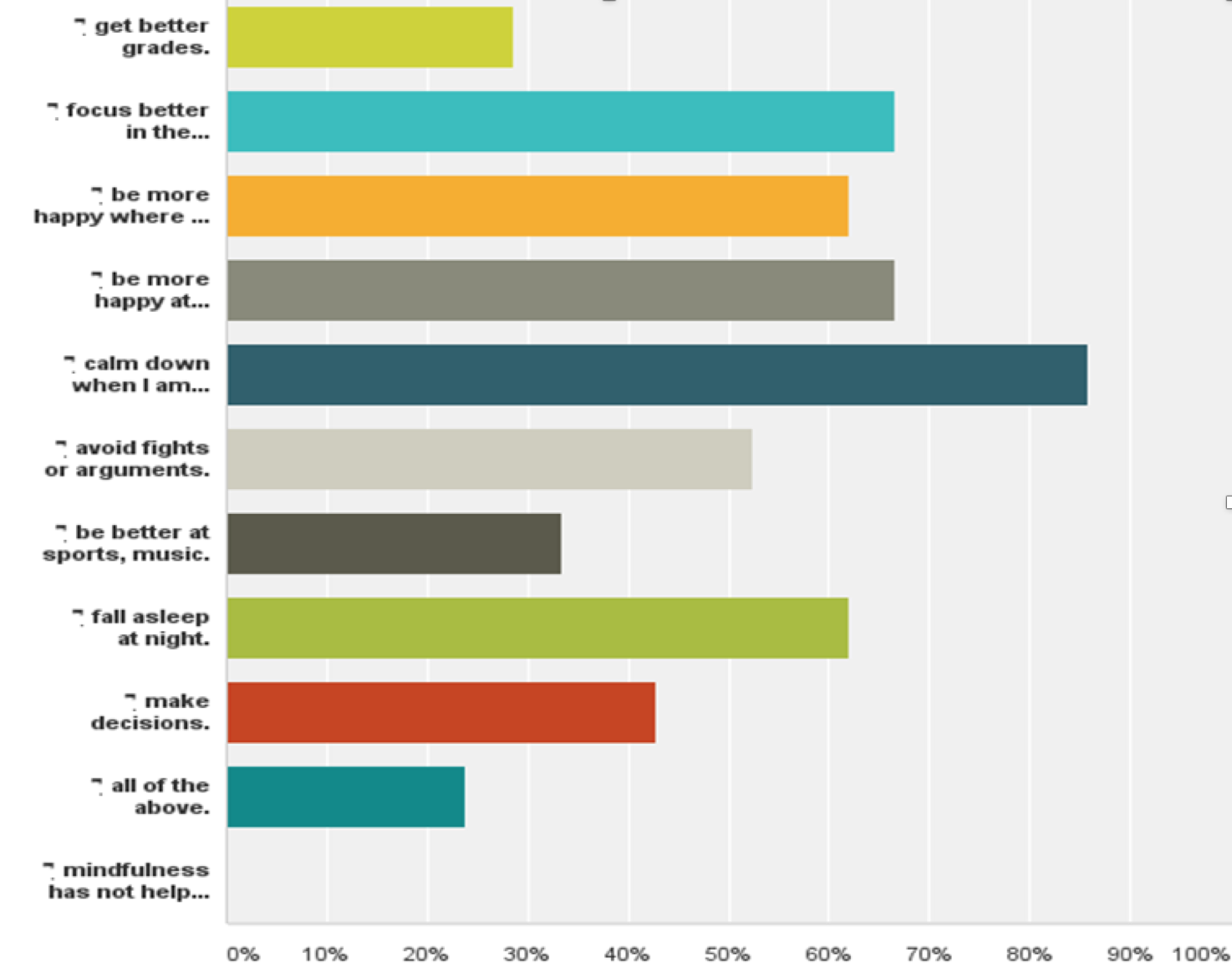
image courtesy Jana York
Significant Outcomes:
100% of the students “enjoyed the mindfulness classes”
85% of the students noted that the lessons helped them “calm down when I am upset”
66% responded that they were able to “focus better in the classroom” as well as “be more happy at school”
61% reported that this helped them to “fall asleep at night” and "be more happy where you live"
Student journal questions:
1. Write about a time you used mindfulness to help you.
2. What is your favorite thing about mindfulness?
Testimonials from 4th graders (as they wrote them, with no editing):
“My friend pushed me into the mud and it got my new pants dirty! I was so mad I was about to yell at her! Then I took deep breaths and she said sorry! If I would've yelled at her we would've lost our friendship! Mindfulness Helps! My favorite thing about mindfulness is me taking time to calm down and to relax! When I am frustrated with my work I do mindfulness and it works”!
“One night I was trying to go to sleep but couldn't. The I used mindfulness, and what do you know, I started sleeping like a baby! My favorite part about mindfulness was when we did mindful walking”.
“One time I used mindfulness to help me was when I was playing basketball with my dad and I kept doing bad throws but when I did mindfulness before I threw the right when I did throw I did it perfectly. My favorite thing about mindfulness is that when your doing a test your mind wanders of but when you do mindfulness during the test you are able to focus”
Survey Results
An 8-week Mindfulness Course for 8th Grade Students
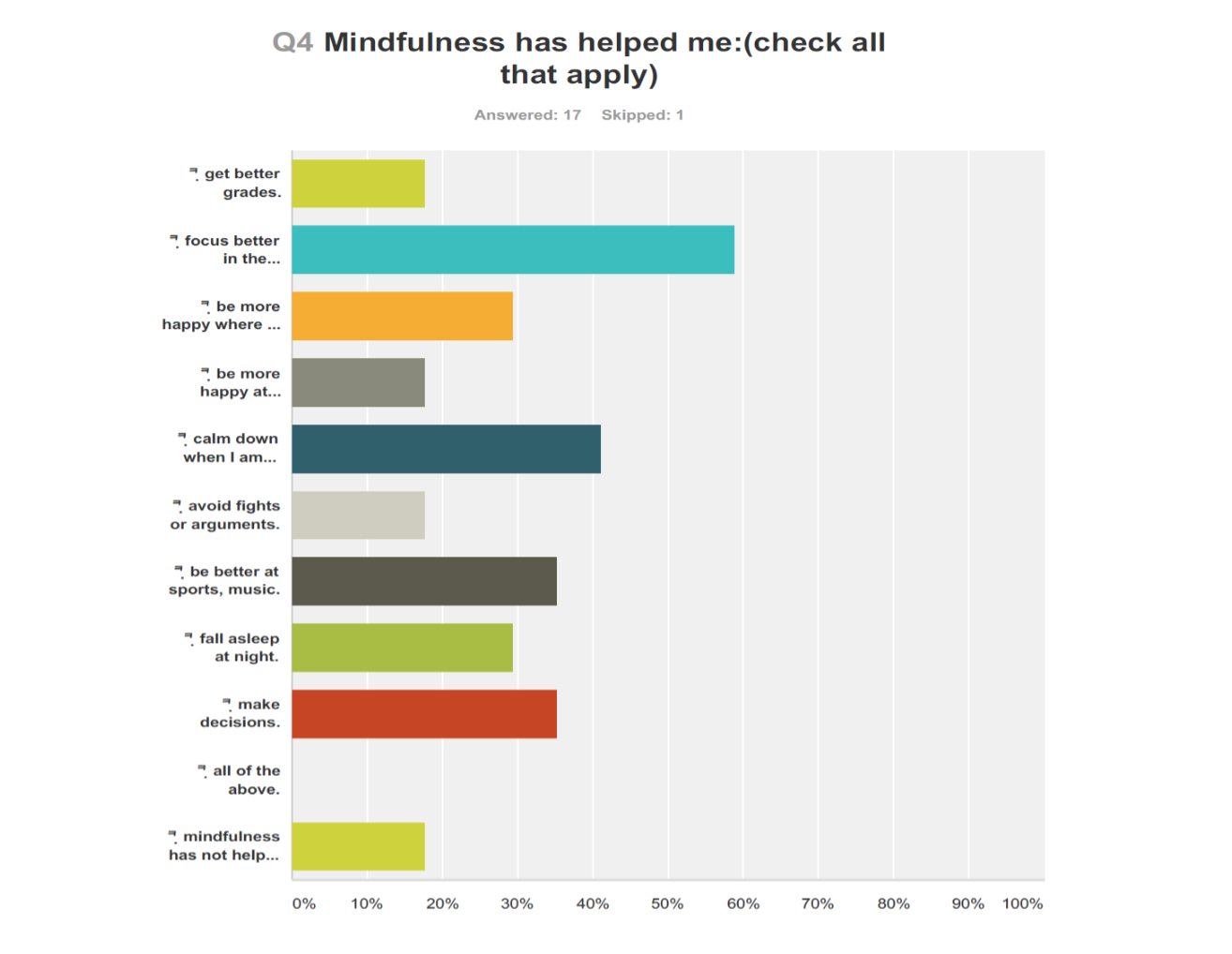
image courtesy Jana York
Significant Outcomes:
100% of the students “enjoyed the mindfulness classes”
58% responded that they were able to “focus better in the classroom”
41% of the students noted that the lessons helped them “calm down when I am upset”
35% of the students noted that they were “better at sports, or music”
29% reported that this helped them “fall asleep at night”
Testimonials from 8th grade students (exactly as they wrote them, with no editing):
“When my sister was being difficult to my parents I used the “finger breathing” method. It really helped me to calm down a lot. To be honest I think my favorite thing about mindfulness is the fact that it will calm me down and I will stop criticizing myself.”
“The time I used mindfulness was when someone made me very upset and I did the mindfulness exercise. This avoided a fist fight. My favorite thing about mindfulness is that you kind of get to relax during that time.”
“I used it in math to open up my mind. It’s cool to be able to hear so many normal thing that we never listen for. It makes me realize how many sounds that we are able to hear, but don’t try to hear.”
“Sometimes at night I find it difficult to sleep. So to help me fall asleep, I use mindful breathing to calm myself down at night. My favorite thing about mindfulness is that it helps me calm down or helps me settle my emotions, such as when I am sad.
Conclusion
“We have a lamp inside us. The oil of that lamp is our breathing, our steps, and our peaceful smile. Our practice is to light up the lamp.”
Thich Nhat Hanh
Mindfulness is already inside of us. It is just a matter of cultivating it and allowing our minds and bodies to be curious, accepting, and vulnerable. Teaching mindfulness to children gives them tools to help cope with stress as well as supplying many other benefits.
Collecting data and soliciting feedback from students not only validates the worth of our program, it also allows us to make a connection with our students and support each other’s well-being.
Wishing you much success in teaching and growing with mindfulness!
About the Author
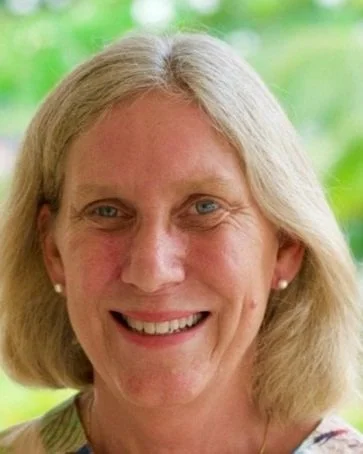
Jana York is a Certified Mindfulness and Meditation teacher and has been a mindfulness practitioner and children’s mindfulness educator for more than a decade, at international schools in Thailand and Japan. Her main passion is teaching children how to reduce anxiety and self-regulate while being in the present moment.
Ms. York is the co-author (with Dr. Amoneeta Beckstein) of Teaching Mindfulness: A Guidebook for Teachers, Parents, Counselors, and Caregivers. She is also the author of U-Is for Understanding – Claire’s Journey toward Mindfulness, a storytelling approach based on an eight-year old’s journey of learning mindfulness in her school. The first three chapters of U is for Understanding, and three of the activities, are available on youtube.
Related Posts
There are many more resources here at Mindful Teachers on the benefits of mindfulness and mindfulness in schools, including:
The Benefits of Mindfulness and Meditation for Kids (Video Playlist)
5 Tips for Successfully Implementing a Mindfulness Program at Your School
Integrating Academics with Mindfulness and SEL
Mindfulness in Schools: Research-Based Support for Teacher Training
Also, be sure to check out these posts by Jana York: