How to Make a Stress Ball with No Mess and Less Stress!
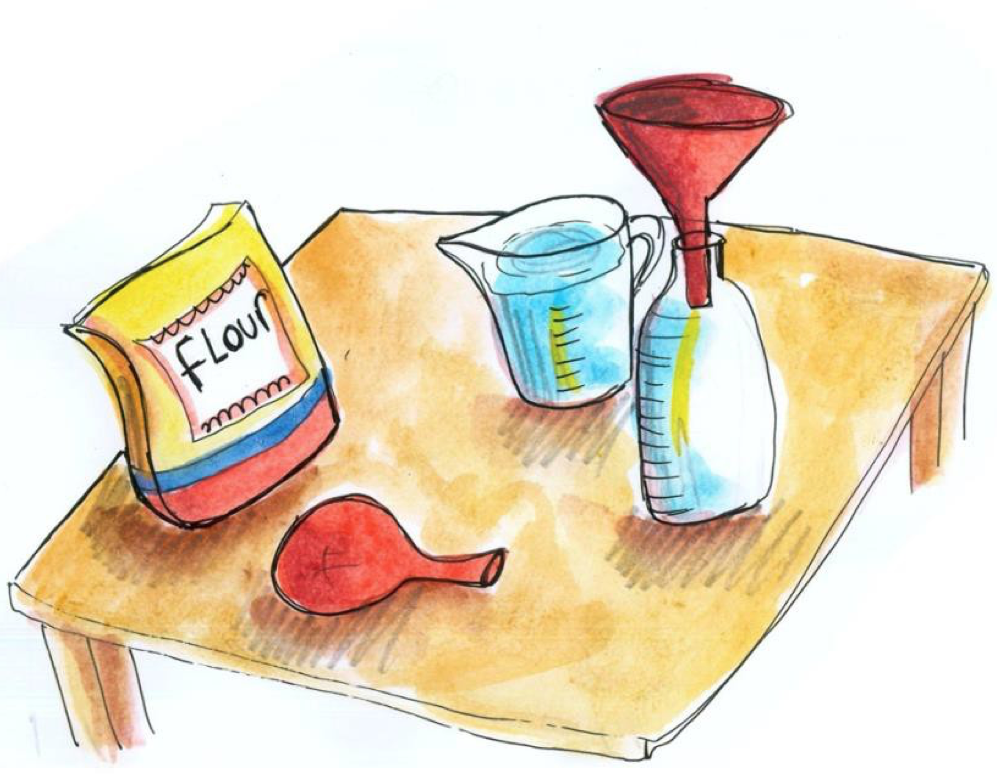
Illustration by Caroline Webb from U is for Understanding
published September 12, 2022
by Jana York, adapted from U is for Understanding – Claire’s Journey Toward Mindfulness
Exploring mindfulness techniques is a time to be curious, to notice your thoughts and reason with big emotions when they arise as you gently tame your inner critic. It is a time to learn and grow together.
Through trial and error of stress ball making as well as other teachings of mindful skills, I have learned a lot. It can be messy and not turn out as you had intended, despite all your preparation and rehearsal.
I have made hundreds of stress balls with children over the years, and there have been some epic fails:
My experiments with glue, corn starch and even shaving cream, proved to be expensive and simply did not work for me as described on instructional videos;
Making a stress ball using rice was great for texture and sensing. However, it yielded some unhappy parents as their child’s stress relieving-toy burst into tiny grains all over the household; and
The most dramatic incident occurred when a stress ball exploded all over the shirt of the head of school. Luckily, she had mindful tools and compassion, which helped her respond with kindness rather than react on impulse. Whew!
As the saying goes, if at first you don’t succeed, try, try again. I eventually developed the following recipe, which is simple, has only a few ingredients, and thus far has stood up over the tests of time and repeated squishing.
How to Make a Stress Ball
with No Mess and Less Stress!
This stress ball activity is from the book U-Is for Understanding – Claire’s Journey toward Mindfulness. It includes a book companion with over 30 activities, including the stress ball. (Special Thanks to Caroline Webb, illustrator of U Is for Understanding, who provided the stress ball image used to illustrate this post. She uses beautiful watercolors to bring the story to life.)
Purposes:
To relieve stress by using your sense of touch.
To distract your mind when you are feeling stress.
Preparation:
Large or wide mouth balloon
Funnel or plastic water bottle (cut near the open area)
Permanent marker
Flour and Water
(in a ratio of 2 parts flour and 1-part water. Example: ½ cup flour, to ¼ cup water)
Instructions:
1. Stretch the balloon by blowing into it a few times.
2. Attach a funnel to the mouth (open end) of the balloon.
3. Sift flour into the balloon and then add water.
4. Remove the funnel.
5. Squeeze the open end of the balloon with one hand to not allow contents to disperse.
6. Tie a knot in the balloon to seal the mixture.
7. Massage the contents from the outside of the balloon to combine water and flour.
8. Draw a face or something fun on the stress ball with a permanent marker.
9. When not using the stress ball, store in the fridge or freezer. It also adds another dimension and sensation to stress release.
Hint: For extra durability wrap another ballon around the stress ball. Be sure to stretch and blow it up a few times, then cut the neck part and work the stress ball into the second balloon. It takes some work, but it will protect the stress ball from bursting.
If you have a great recipe for stress ball making or any other mindfulness gadget, I would love to hear about them. You can reach me at Janayork.mindful@gmail.com.
About the Author

Jana York is a Certified Mindfulness and Meditation teacher and has been a mindfulness practitioner and children’s mindfulness educator for more than a decade, at international schools in Thailand and Japan. Her main passion is teaching children how to reduce anxiety and self-regulate while being in the present moment.
Ms. York is the co-author (with Dr. Amoneeta Beckstein) of Teaching Mindfulness: A Guidebook for Teachers, Parents, Counselors, and Caregivers. She is also the author of U-Is for Understanding – Claire’s Journey toward Mindfulness, a storytelling approach based on an eight-year old’s journey of learning mindfulness in her school. The first three chapters of U is for Understanding, and three of the activities, are available on youtube.
Related Posts
There are many more resources on stress reduction and mindfulness here at Mindful Teachers, org, including the following posts:
Q + A with Jana York: Best Practices in Teaching Mindfulness to Adults And Kids